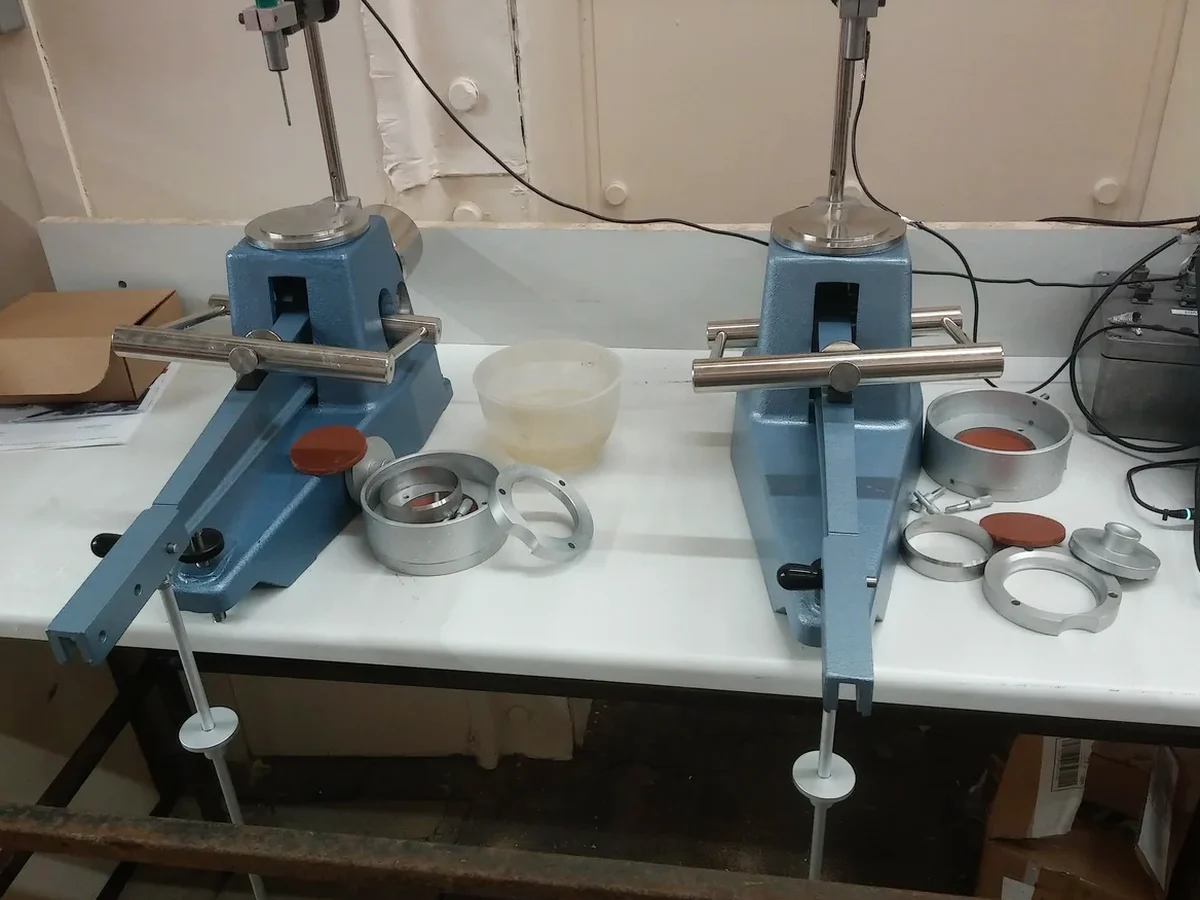
A common mistake among contractors in Coffs Harbour is assuming all clay soils behave the same. The region's weathered shales and basaltic clays can shift from low to extremely high plasticity within a single site. Without Atterberg limits, you might design foundations for a soil that swells when wet and shrinks during dry spells. That leads to cracked slabs and costly callbacks. Testing according to AS 1726 gives you the liquid limit, plastic limit, and plasticity index needed to classify the soil correctly. For projects on expansive ground, pair this data with an asentamientos analysis to predict differential movement before pouring concrete.
Plasticity index above 35 in Coffs Harbour clays signals high shrink-swell potential requiring engineered fill or deep foundations.
Method and coverage
AS 1289.3.1.1, AS 1289.3.2.1, and AS 1289.3.3.1 govern Atterberg limits testing in Australia. In Coffs Harbour, where annual rainfall exceeds 1,600 mm and clay profiles are deep, these standards are non-negotiable. The test sequence involves three steps:
Liquid limit: Casagrande cup method or cone penetrometer per AS 1289.3.1.1.
Plastic limit: Rolling threads to 3 mm diameter per AS 1289.3.2.1.
Plasticity index: Calculated difference between liquid and plastic limits.
Results feed directly into the Unified Soil Classification System. When the PI exceeds 35, you need special foundation design. For fills where water content is critical, combine Atterberg limits with a densidad-cono-arena to verify compaction meets specifications.
Technical reference image — Coffs Harbour
Regional considerations
Compare the sandy alluvium along Boambee Creek with the residual clay on the hills of Moonee Beach. The former has a plasticity index around 12, while the latter can exceed 45. A slab designed for the lower value will fail on the higher one. Differential heave tears walls, warps doors, and cracks pavements. Atterberg limits catch these extremes before you pour. In Coffs Harbour's variable geology, skipping this test is a gamble with the structure's long-term stability.
Full suite of liquid limit, plastic limit, and plasticity index tests per AS 1289 standards. Suitable for foundation design, pavement subgrade classification, and earthworks quality control.
02
Expansive Soil Identification
Focused assessment for high-plasticity clays common in Coffs Harbour's northern suburbs. Includes shrinkage index and free swell index when requested.
03
Combined Classification Package
Atterberg limits plus sieve analysis and hydrometer for complete USCS classification. Ideal for large subdivisions or road projects requiring consistent soil profiles.
This service complements our laboratory testing work for a complete project analysis.
Standards that apply
AS 1289.3.1.1 (Liquid limit – Casagrande method), AS 1289.3.2.1 (Plastic limit), AS 1289.3.3.1 (Plasticity index calculation), AS 1726:2017 (Geotechnical site investigations)
Top questions
What is the difference between liquid limit and plastic limit?
The liquid limit is the water content where soil changes from liquid to plastic behavior, measured with a Casagrande cup or cone penetrometer. The plastic limit is the water content where soil begins to crumble when rolled into a 3 mm thread. Their difference gives the plasticity index, which indicates how much the soil's strength changes with moisture. In Coffs Harbour clays, a high PI means the ground will move significantly with seasonal rain.
How much does Atterberg limits testing cost in Coffs Harbour?
Typical pricing ranges between AU$110 and AU$150 per sample for standard LL, PL, and PI tests. The final cost depends on sample preparation, number of determinations, and whether additional tests like linear shrinkage are included. Volume discounts apply for large subdivision projects.
When should I request Atterberg limits instead of just a soil classification?
You need Atterberg limits whenever the soil contains fines (silts or clays) and the design depends on moisture sensitivity. For example, in Coffs Harbour's residential slabs, a plasticity index above 25 triggers specific engineering measures per AS 2870. A visual classification alone cannot quantify that risk. Always request Atterberg limits for pavement subgrades, earth dam cores, and foundation bearing layers.