Coffs Harbour sits on a coastal plain underlain by Quaternary alluvium and residual soils derived from the Coffs Harbour Block, a meta-sedimentary formation that produces sandy clays with variable permeability. Shallow groundwater tables between 1.5 and 3 m depth are common near the harbour and along the Boambee Creek corridor. An infiltration test using either the Porchet or double-ring infiltrometer method provides the direct field measurement needed to design onsite wastewater systems, stormwater infiltration basins, and drainage layers. The test quantifies the steady-state infiltration rate in mm/h, which governs the sizing of soakage trenches and rain gardens across residential lots in Coffs Harbour. Before scheduling the infiltration test, a preliminary calicatas exploratorias allows visual classification of the soil profile, and where hydraulic conductivity anisotropy is suspected, a permeabilidad campo test can be run in parallel to compare vertical vs horizontal flow rates. These complementary measurements ensure the design infiltration rate reflects the actual ground conditions rather than a single-point estimate.
Steady-state infiltration rates in Coffs Harbour sandy clays range from 10 to 40 mm/h, dropping below 5 mm/h in clay-rich horizons near the bypass corridor.
Method and coverage
Coffs Harbour records average annual rainfall above 1,600 mm, which places high demand on onsite drainage systems to manage percolation without surface ponding. The infiltration test protocol follows AS 4678:2002 for earth-retaining structures and the NSW Onsite Wastewater Management Guidelines. Key parameters measured include the saturated hydraulic conductivity (Ksat) in mm/h and the time to reach steady-state flow. The double-ring infiltrometer method isolates one-dimensional vertical flow, reducing lateral divergence errors common in single-ring setups. Typical Ksat values for the sandy clays of Coffs Harbour range from 10 to 40 mm/h, but can drop below 5 mm/h in clay-rich horizons near the Coffs Harbour Bypass corridor. The test also records the cumulative infiltration curve, which engineers use to estimate soil sorptivity. For site-specific correlation with grain-size distribution, a granulometria analysis of the same horizon refines the permeability estimate. When the infiltration rate is critical for a detention basin design, combining the test with an ensayo proctor compaction reference ensures the fill placement does not alter the native hydraulic behaviour.
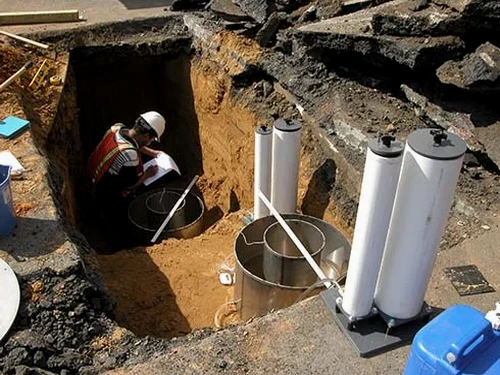
Technical reference image — Coffs Harbour
Regional considerations
A common mistake by developers in Coffs Harbour is relying on a single infiltration hole near the road frontage, where the soil may be compacted or disturbed from utility trenching. This yields rates that are either too high (through preferential flow paths) or too low (through compaction), leading to undersized or oversized soakage systems. Undersized systems cause surface ponding within the first wet season, especially in low-lying areas around the Coffs Harbour Jetty. Oversizing wastes land and increases earthworks cost. The infiltration test should be performed at the actual location of the proposed drainage element, at the same depth, and after the soil has been wetted to field capacity to simulate worst-case conditions. Without this site-specific measurement, the hydraulic design is speculative.
Porchet (single-ring) or double-ring infiltrometer
Measured parameter
Steady-state infiltration rate (mm/h)
Typical range in Coffs Harbour
10 – 40 mm/h (sandy clay); <5 mm/h (clay-rich)
Test duration
2 – 6 hours depending on soil permeability
Water head maintained
Constant head of 100–300 mm above ground surface
Applicable standard
AS 4678:2002, NSW Onsite Wastewater Guidelines
Related services
01
Porchet (Single-Ring) Infiltration Test
A cost-effective test for residential soakage trenches and rain gardens. A 300 mm diameter ring is driven 150 mm into the soil, filled with water, and the drop in head recorded over time until steady state is reached. Suitable for sandy clays with infiltration rates above 10 mm/h.
02
Double-Ring Infiltrometer Test
Two concentric rings (300 mm inner, 600 mm outer) isolate vertical flow, eliminating lateral divergence. Recommended for stormwater detention basins and commercial-scale soakage systems in Coffs Harbour where accuracy of Ksat is critical for hydraulic design.
03
Permeability Correlation & Reporting
We cross-reference infiltration results with grain-size distribution and compaction data to provide a site-specific hydraulic conductivity estimate. The report includes cumulative infiltration curves, Ksat values, and design recommendations compliant with AS 4678 and local council requirements.
This service complements our laboratory testing work for a complete project analysis.
Standards that apply
AS 4678:2002 – Earth-retaining structures (infiltration for drainage), NSW Onsite Wastewater Management Guidelines (Part 4 – Soil Assessment), AS 1289.6.8.1 – Standard Test Method for Infiltration Rate of Soils in Field Using Double-Ring Infiltrometer
Top questions
How much does an infiltration test cost in Coffs Harbour?
The typical price for a single infiltration test (Porchet or double-ring) in Coffs Harbour ranges between AU$500 and AU$560. This includes on-site testing, data analysis, and a summary report. Costs may vary if multiple test locations are required or if access is difficult due to steep slopes or dense vegetation.
What is the difference between the Porchet and double-ring infiltrometer methods?
The Porchet method uses a single ring and measures a combined vertical-lateral flow, which can overestimate vertical infiltration in heterogeneous soils. The double-ring infiltrometer has an outer ring that saturates the surrounding soil, forcing flow in the inner ring to be predominantly vertical. For Coffs Harbour's layered sandy-clay profiles, the double-ring method gives a more accurate Ksat for design purposes.
At what depth should the infiltration test be performed for a soakage trench?
The test should be conducted at the depth of the proposed trench base, typically 600–800 mm below natural surface. In Coffs Harbour, the shallow water table may be encountered at 1.5–2 m, so testing at the trench depth ensures the design rate reflects the soil horizon that will receive the discharge. If the water table is within 1 m of the surface, a perched water table assessment may be needed.