← Home · Foundations

Settlement Analysis in Coffs Harbour – Geotechnical Assessment

Together, we solve the challenges of tomorrow.

DETAILS →

A commercial development we worked on near Harbour Drive showed floor slabs cracking within six months of completion. The cause was differential settlement across a transition zone between colluvium and residual soil. For a site like Coffs Harbour, where the bedrock profile varies sharply within metres, a standard bearing capacity check is not enough. We run settlement analysis using one-dimensional consolidation data and elastic theory to predict both immediate and long-term movements. Before pouring any footing, we cross-check the profile with a capacidad de carga study to verify that the allowable bearing pressure keeps settlements under 25 mm. In some cases, the client also asked for columnas de grava to accelerate consolidation in the soft marine clays near the creek.
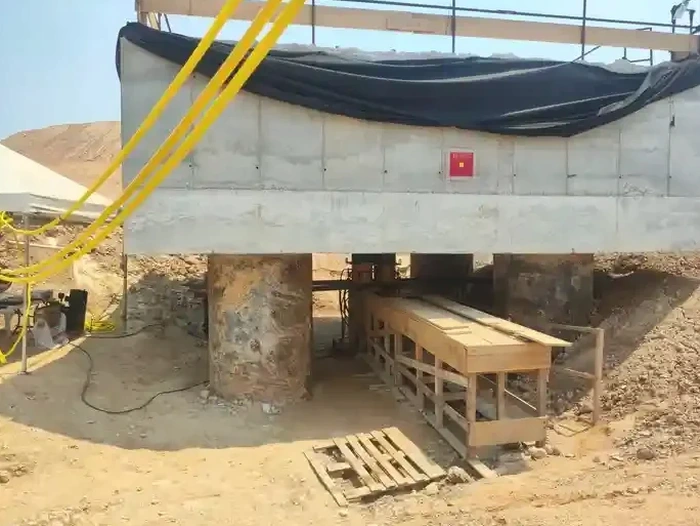
Illustrative image of Settlement analysis in Coffs Harbour
Differential settlement in Coffs Harbour’s variable geology can exceed 40 mm across a single building footprint without proper consolidation analysis.

Method and coverage

Coffs Harbour receives over 1600 mm of rainfall annually, which keeps the water table high in the low-lying suburbs near the jetty. Saturated soils with low permeability can delay primary consolidation by years if the drainage path is long. Our settlement analysis follows AS 1726-2017 and uses oedometer tests to determine the compression index (Cc) and recompression index (Cr). We also measure the coefficient of consolidation (Cv) to estimate time rates. For the sandy colluvium on the hillsides above the city, immediate settlement often governs, so we apply Schmertmann’s method using CPT data. The analysis always includes a factor for creep in the soft estuarine deposits that underlie parts of the Boambee Creek area. Complementing this with a georradar-gpr survey helps us map hidden paleochannels that could cause unexpected settlement.
Technical reference image — Coffs Harbour

Regional considerations

The difference between building on the sandy ridge near Korora versus the estuarine flats along the Coffs Creek corridor is night and day. On the ridge, settlement is mostly elastic and happens during construction. On the flats, primary consolidation can take years, and secondary compression (creep) can add another 10–15 mm over the life of the structure. If the design ignores the creep component in the soft marine clays, the floors will tilt, and the façade will crack. A proper settlement analysis captures both the magnitude and the time rate so the structural engineer can decide whether to use a raft slab, deep piles, or Improvement.

Need a geotechnical assessment?

Reply within 24h.

Email: contact@geotechnicalengineering1.xyz

Technical parameters


ParameterTypical value
Compression index (Cc)0.15 – 0.45 (soft clay)
Coefficient of consolidation (Cv)1 – 10 m²/year
Immediate settlement (elastic)10 – 30 mm (sand colluvium)
Allowable total settlement (typical)25 mm (AS 2870)
Time to 90% consolidation2 – 8 years (soft clay, 3 m layer)

Related services

01

Consolidation settlement analysis

One-dimensional consolidation modelling using oedometer data. We calculate total and differential settlement for soft clay layers, including time-rate predictions for staged construction.

02

Immediate settlement assessment

Elastic settlement analysis for sandy colluvium and residual soils using CPT and SPT data. We apply Schmertmann’s strain influence method to match local conditions.

03

Long-term creep and secondary compression

Evaluation of secondary compression index (Cαε) for estuarine deposits. We provide settlement–time curves that extend beyond primary consolidation to cover the building’s service life.

This service complements our laboratory testing work for a complete project analysis.

Standards that apply


AS 1726-2017 Geotechnical site investigations, AS 2870-2011 Residential slabs and footings, FHWA Schmertmann method for immediate settlement, Terzaghi one-dimensional consolidation theory

Top questions

How long does a typical settlement analysis take for a site in Coffs Harbour?

A standard settlement analysis with oedometer testing takes two to three weeks from sample collection to final report. If we already have borehole data, we can deliver the calculation within five working days.

What is the difference between immediate settlement and consolidation settlement?

Immediate settlement occurs elastically as load is applied and is dominant in sands and colluvium. Consolidation settlement is time-dependent and occurs in saturated clays as pore water dissipates. In Coffs Harbour, both mechanisms can act on the same site if the profile has interbedded sand and clay layers.

How much does a settlement analysis cost in Coffs Harbour?

For a typical residential or low-rise commercial site, the cost ranges between AU$990 and AU$2,440 depending on the number of boreholes, lab tests, and the complexity of the soil profile. We provide a fixed quote after reviewing the site conditions.

Location and service area

We serve projects across Coffs Harbour.

Location and service area