The humid subtropical climate of Coffs Harbour, with annual rainfall exceeding 1,600 mm, saturates the alluvial floodplains and estuarine deposits along the Coffs Creek and Boambee Creek corridors. These soft, compressible clays and silts present a classic geotechnical challenge for any medium-to-heavy structure. Stone column design offers a proven Improvement strategy that densifies the matrix, accelerates consolidation through radial drainage, and provides a stiff composite foundation. Before specifying the column grid, the team typically cross-references the stratigraphy from a series of calicatas exploratorias to map the soft layer thickness, then runs ensayo CPT soundings to capture continuous cone resistance and pore pressure profiles down to the bearing stratum.
Stone columns reduce total settlements by 40–70% in soft clays while increasing the factor of safety against bearing failure by a factor of 2 to 3.
Method and coverage
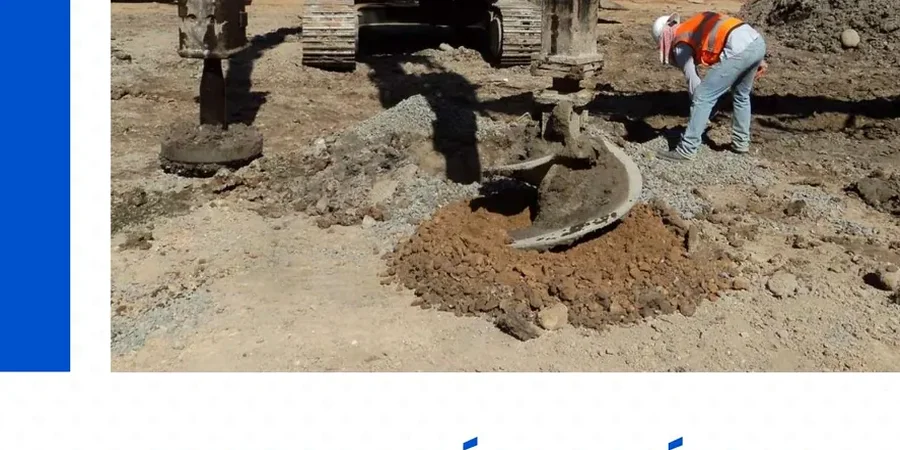
Installation in Coffs Harbour relies on either the vibro-replacement (wet top-feed) or vibro-displacement (dry bottom-feed) method, depending on the groundwater table and fines content of the native soil. The vibrator penetrates under its own weight and the lateral displacement of the soil creates a cavity that is backfilled with selected granular material — typically a well-graded crushed rock with a maximum particle size of 75 mm. The equipment includes a 30-tonne crawler crane, a 150 kW electric vibrator, and a real-time monitoring system that records depth, current draw, and compaction energy per lift. Each stone column is designed to a diameter of 0.8 to 1.2 m and a spacing of 1.5 to 3.5 m in a triangular grid, achieving area replacement ratios between 10% and 35%. The design verification includes post-treatment placa de carga tests to confirm the modulus of subgrade reaction and load-settlement behaviour under working loads.
Technical reference image — Coffs Harbour
Regional considerations
Coffs Harbour lies in a region of moderate seismicity, with a peak ground acceleration (PGA) of 0.08 g for a 500-year return period per AS 1170.4. Under dynamic loading, soft saturated soils are prone to liquefaction and excess pore pressure build-up. Stone column design mitigates this risk by providing drainage paths that dissipate pore pressures rapidly, preventing strength loss during a seismic event. The columns also increase the overall shear stiffness of the ground, reducing the cyclic strain amplitude and the potential for lateral spreading. In the Coffs Harbour marina precinct and low-lying residential developments near the jetty, this improvement is critical for achieving code-compliant foundation performance under earthquake loading.
Review of existing borehole logs, CPTu profiles, and laboratory data to evaluate the applicability of stone column treatment for the specific soft soil conditions in Coffs Harbour.
02
Detailed Column Layout and Bearing Capacity Design
Calculation of column diameter, spacing, and length using Priebe's method and finite element analysis (PLAXIS 2D) to achieve target settlement limits and factor of safety against bearing failure.
03
Construction Supervision and QA/QC Testing
On-site monitoring of vibrator energy consumption, backfill grading, and column integrity. Post-construction load testing and CPTu soundings to verify design assumptions and performance.
Standards that apply
AS 1726-2017 Geotechnical site investigations, AS 4678-2002 Earth-retaining structures, AS/NZS 1170.4:2007 Structural design actions – Earthquake actions, FHWA-RD-83-026 Design and construction of stone columns
Top questions
What typical settlements can be expected after stone column treatment in Coffs Harbour's soft clays?
In the soft estuarine clays of Coffs Harbour, total settlements under working loads are typically reduced from 150–300 mm to 50–100 mm, depending on the column spacing and area replacement ratio. Differential settlements are also minimised due to the stiff composite ground response.
How much does stone column design and installation cost in Coffs Harbour?
The cost ranges between AU$2,050 and AU$7,830 per column, depending on column diameter, depth, and access conditions. A detailed quotation is prepared after reviewing the site-specific ground conditions and project scope.
What is the maximum depth achievable with vibro-replacement stone columns in Coffs Harbour?
Vibro-replacement stone columns can be installed to depths of up to 15 m in the Coffs Harbour region, limited by the vibrator power and the ability to maintain column integrity through the soft layers. Depths beyond 15 m may require alternative Improvement methods such as deep soil mixing.