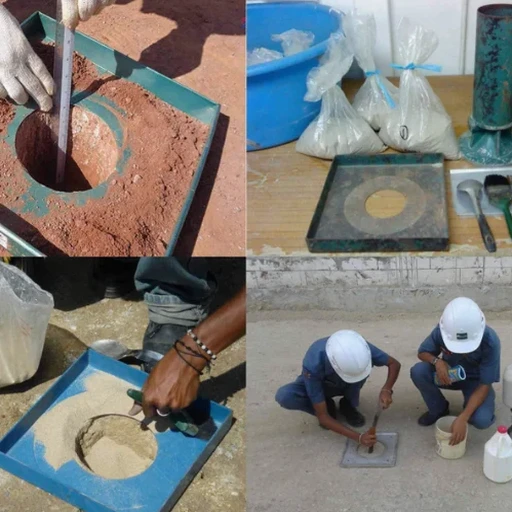
Coffs Harbour's subtropical climate, with annual rainfall exceeding 1,600 mm concentrated between January and March, creates a challenging environment for earthworks compaction control. The sand cone method remains the most reliable in-situ density test for granular fills and cohesive subgrades across the Coffs Harbour region. We apply this technique under AS 1289.5.3.1 to verify that compacted layers achieve the required dry density ratio before subsequent lifts are placed. When the surface is too soft for safe access, we complement the sand cone with a plate load test to confirm bearing capacity directly on the same horizon.
Sand cone testing at Coffs Harbour coastal fills consistently shows that moisture content 2% above optimum can reduce dry density ratio by 5 percentage points.
Method and coverage
In Coffs Harbour we frequently observe that contractors underestimate the effect of high soil moisture on sand cone results. The test procedure involves excavating a small cylindrical hole, carefully collecting all excavated material, and filling the void with calibrated sand from a pre-weighed jar. We then determine the in-situ wet density and, combined with laboratory moisture content, compute the dry density. This value is compared against the maximum dry density from the relevant Proctor compaction standard. For projects requiring deeper compaction verification, we coordinate the field density test with dynamic cone penetrometer profiling to assess strength variability across the fill depth.
Technical reference image — Coffs Harbour
Regional considerations
Coffs Harbour's urban expansion into former floodplains and low-lying coastal areas has brought many marginal fills under scrutiny. A field density test failure on a housing estate near the Jetty foreshore area forced a complete redesign of the pavement subgrade after the sand cone revealed only 89% of standard Proctor density against the specified 95%. The cost of removing and recompacting 3,500 m³ of fill exceeded the entire testing budget and delayed the project by six weeks. Such cases underscore why early compaction control using the sand cone method is not a formality but a necessity for any significant earthworks in Coffs Harbour.
In-situ dry density determination using calibrated sand per AS 1289.5.3.1. Suitable for fills, subgrades, and pavement layers with particle sizes up to 50 mm. Results reported within 48 hours.
02
Moisture Content Verification
Oven-dry moisture content determination per AS 1289.2.1.1, essential for interpreting field density results and adjusting compactive effort on site.
03
Compaction Compliance Reporting
Comprehensive compliance reports comparing field density results against specified maximum dry density and optimum moisture content, including statistical evaluation of test batches.
Standards that apply
AS 1289.5.3.1 – Soil compaction and density tests: Determination of the field density of a soil – Sand replacement method, AS 1289.2.1.1 – Soil moisture content tests: Determination of the moisture content of a soil – Oven drying method, AS 1289.5.1.1 – Soil compaction and density tests: Determination of the dry density/moisture content relation of a soil – Standard compactive effort, AS 1289 – Standard Test Method for Density and Unit Weight of Soil in Place by Sand-Cone Method
Top questions
How does the sand cone method differ from nuclear gauge density testing?
The sand cone method is a direct volumetric test that measures actual soil density without radiation licensing requirements. It is more accurate in saturated or high-moisture soils common in Coffs Harbour coastal fills, whereas nuclear gauges can be affected by moisture and require calibration correction. The sand cone is slower but provides legally defensible results for specification compliance.
What is the typical cost range for a sand cone field density test in Coffs Harbour?
A single sand cone test including excavation, sand calibration, moisture determination, and reporting typically ranges between AU$140 and AU$260. Volume discounts apply for projects requiring 10 or more tests, and rates may vary slightly depending on site access conditions and required turnaround time.
At what frequency should sand cone tests be performed during earthworks in Coffs Harbour?
For structural fills under AS 4678, we recommend one test per 200 m³ of compacted fill or per 500 m² of area per lift, whichever is more frequent. In Coffs Harbour’s variable soil conditions, increasing test frequency to one per 150 m³ during wet weather periods provides better control against moisture-related density loss.